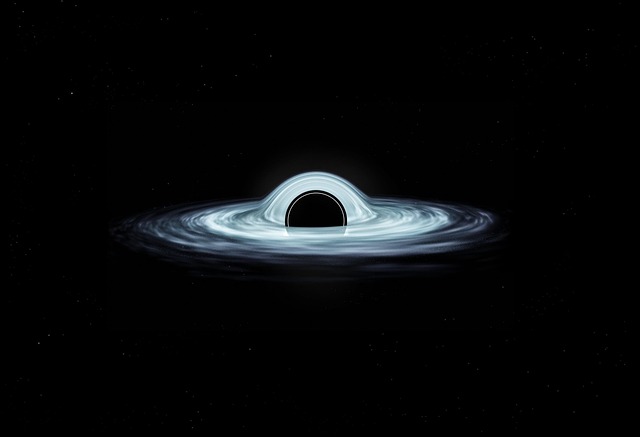
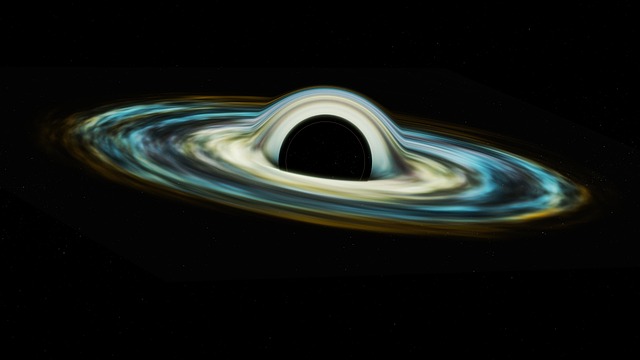
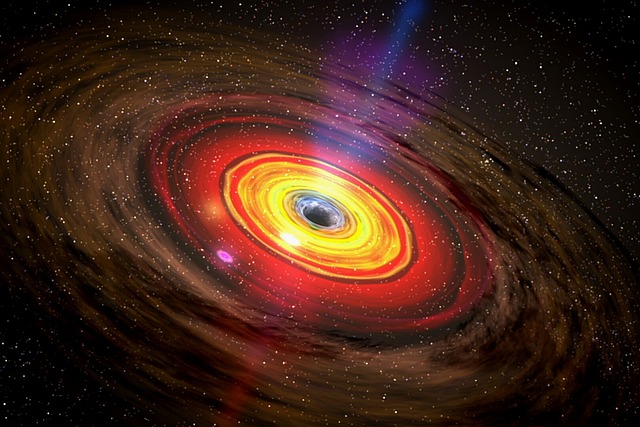
What lies within a black hole remains one of the most perplexing questions in modern science. Some speculative theories suggest these cosmic objects might act as gateways to other universes, or perhaps even contain miniature universes of their own. Such ideas remain on the fringes of theoretical physics, however. In truth, scientists still cannot say with certainty what occurs inside them.
++ Study raises concerns over AI-Generated diet plans for teenagers
The difficulty stems from the black hole’s event horizon — the boundary beyond which nothing can escape its immense gravitational pull, not even light or information. Because of this barrier, the interior of a black hole remains fundamentally hidden from observation. Current physical theory predicts that at the centre lies a singularity: a point of seemingly infinite density where the known laws of physics begin to break down. While such a concept appears physically implausible, it remains the most widely accepted explanation available.
Yet mathematics may offer another path towards understanding these enigmatic objects. Some theorists now argue that the internal structure of black holes could be described using a concept many people last encountered in school mathematics: prime numbers. According to emerging research discussed in Scientific American, hypothetical entities linked to prime numbers — dubbed “prime number particles” — might exist at the core of a black hole. These theoretical particles could form a swirling structure within the singularity.
Eric Perlmutter, a physicist at the Institute of Theoretical Physics in France, noted that many specialists in high-energy physics are not deeply familiar with this area of mathematics. “I’d say many high-energy physicists don’t actually know much about that side of number theory,” he told the magazine.
Prime numbers themselves are straightforward to define. They are natural numbers that cannot be divided evenly by any other numbers except one and themselves. Examples include 2, 3, 5, 7, 11 and 13. Crucially, every whole number can be broken down into a product of primes. For that reason, mathematicians regard them as the fundamental building blocks of arithmetic — much like fundamental particles serve as the basic components of matter in physics.
Much of the interest surrounding primes comes from the famous Riemann Hypothesis. First proposed in 1859 by the German mathematician Bernhard Riemann, the conjecture attempts to explain the apparently irregular distribution of prime numbers along the number line. Despite more than a century and a half of intense study, the hypothesis remains unsolved. A proof would earn its discoverer a prize of one million dollars.
In the late twentieth century, physicist Bernard Julia explored the idea of linking prime numbers to particle physics. He imagined a type of elementary particle whose energy levels corresponded to prime numbers. These theoretical entities were named “primons”, and collections of them were described as a “primon gas”. Julia found that the mathematical function governing this system matched the Riemann zeta function — the same formula that sits at the heart of the Riemann Hypothesis.
Although primons remain purely theoretical, recent work suggests that the concept may not be entirely abstract. A study published in 2025 by physicists at the University of Cambridge reported that the quantum behaviour near a black hole’s singularity appeared to organise itself into patterns resembling a cloud of primon gas, following a conformal distribution linked to prime numbers.
++ Britain’s creepiest churches with chilling legends
In a subsequent paper, the researchers proposed an even more unusual possibility. If the universe contained five spatial dimensions rather than the familiar four dimensions of space-time, the singularity might require a more exotic mathematical description based on so-called Gaussian prime numbers. Sean Hartnoll, the Cambridge physicist who led the research, emphasised that the significance of these patterns remains uncertain. “We don’t know yet whether the appearance of prime number randomness close to a singularity has a deeper meaning,” he told Scientific American. “However, to my mind, it is very intriguing that the connection extends to higher-dimensional theories of gravity.”
For now, the relationship between prime numbers and black holes remains speculative. Nevertheless, the idea highlights how mathematics continues to offer unexpected insights into some of the universe’s most profound mysteries.


